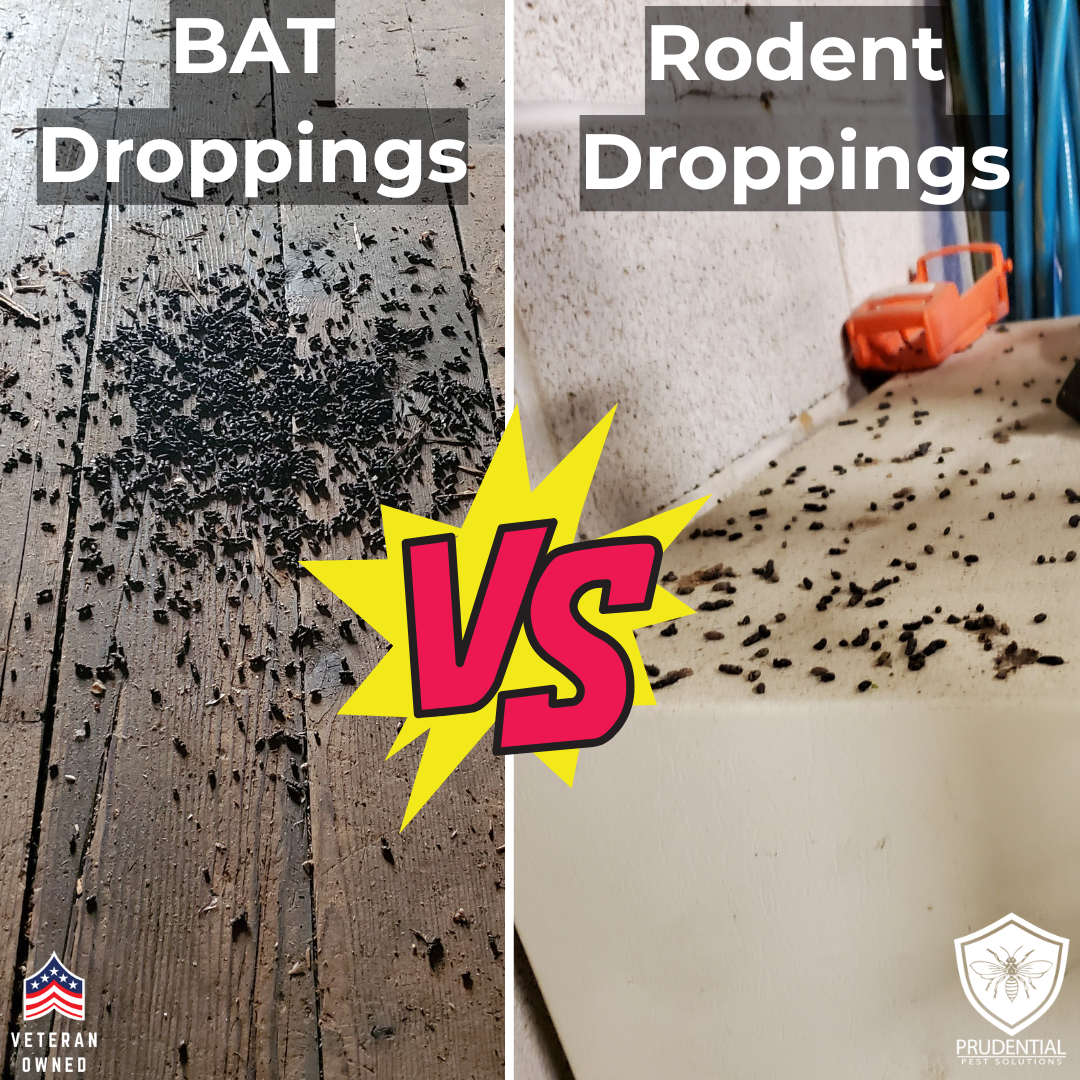
Homeowners in Pennsylvania often discover small black droppings in attics, basements, garages, or along walls and immediately wonder: “Are these bat droppings or rodent droppings?”
Knowing the difference is critical because bats and mice require completely different removal and cleanup approaches.
Before you can perform any sort of clean-up of the droppings, it’s important to identify what animal made the droppings. Are you dealing with bat droppings or mouse droppings?
Once you know that, you can treat for the problem and then deal with the clean-up of the droppings.
Below are some very important tips on how to identify bat droppings vs mouse droppings and how it can be removed safely.
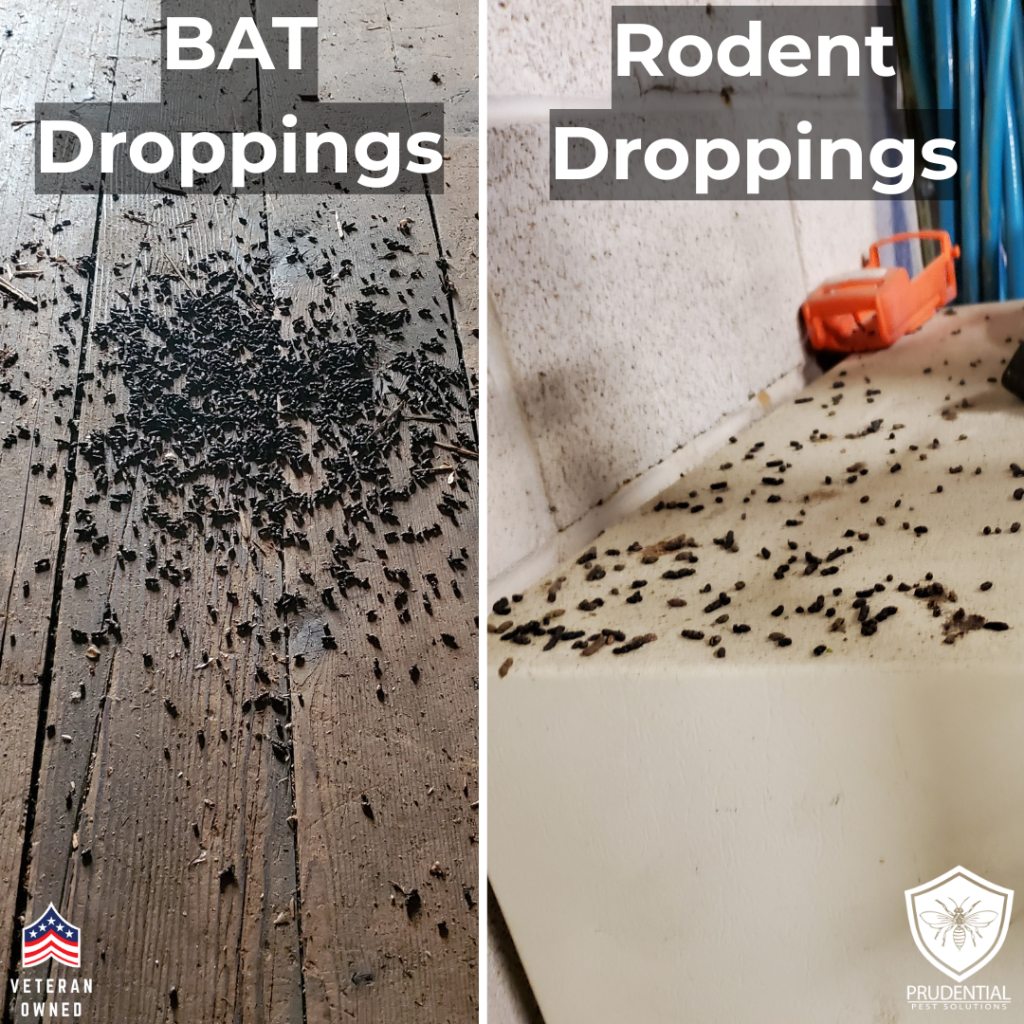
How can we tell the difference between bat and mouse droppings?
- Where are you seeing the droppings?
- Have you seen any mice or bats in the house or attic?
- Are the droppings in the middle of the attic floor or along the edges of the wall.
- Are there piles of droppings or are the droppings scattered or few and far between?
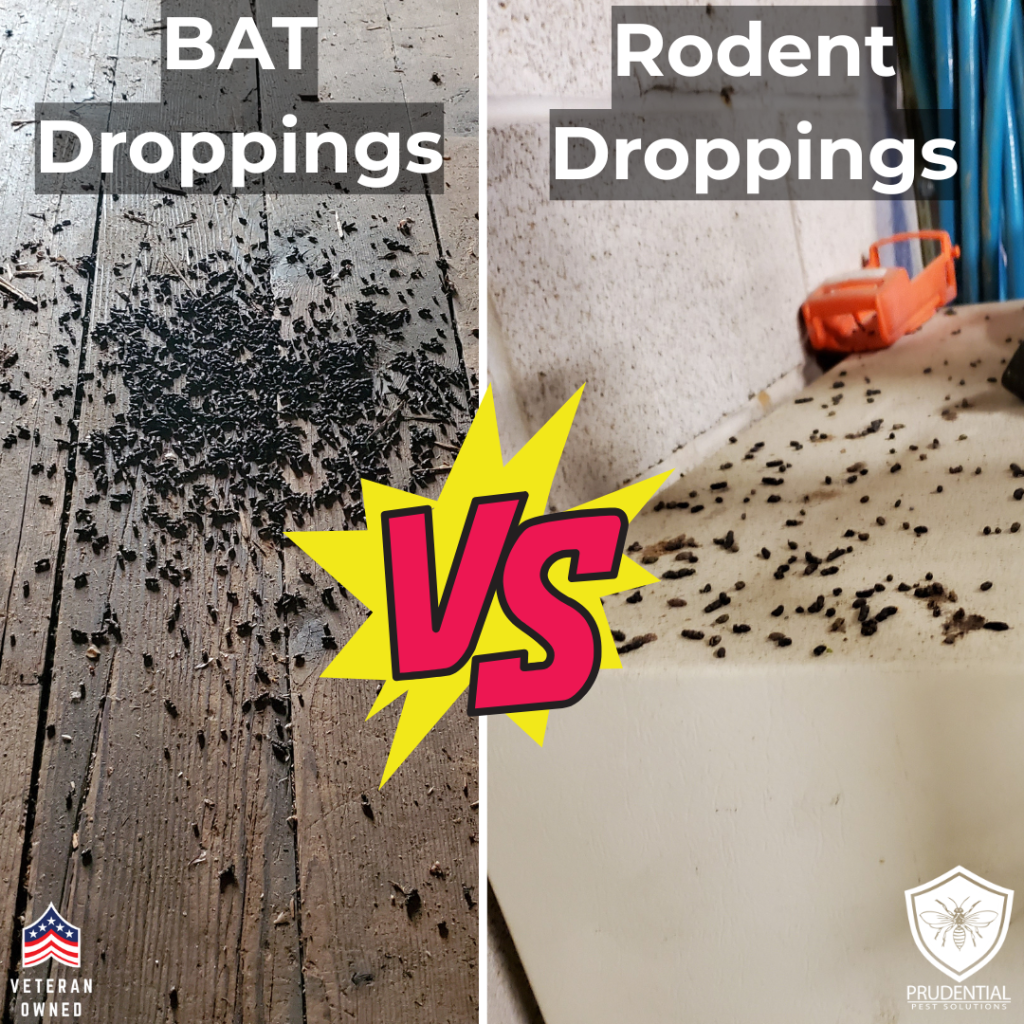
Bat Droppings (Guano)
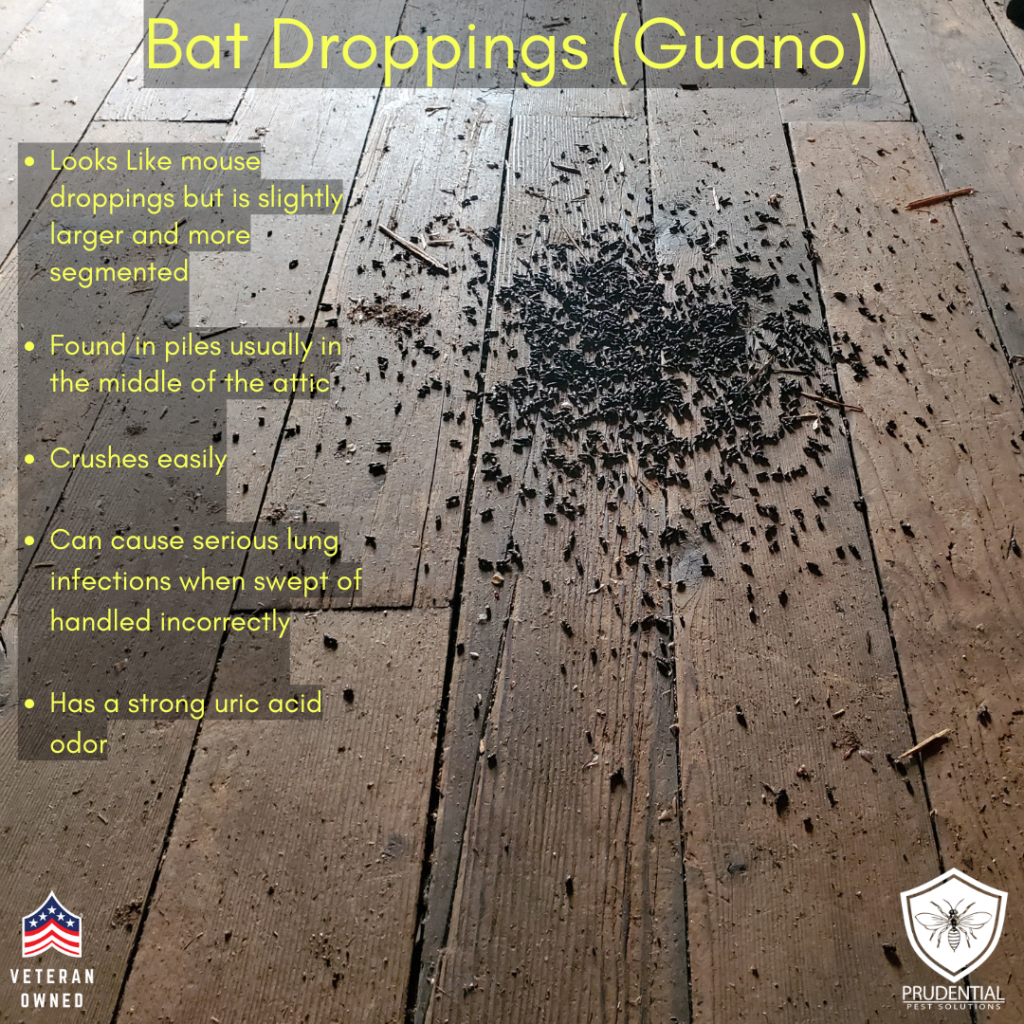
- Similar in size to mouse droppings with an oval or elongated shape.
- Segmented in the middle with an elongated hour-glass shape
- Crumble and are crushed very easily
- Accumulate in piles in the middle of the attic, under shutters, or on the porch or patio
- Hazards of bat droppings are respiratory infections such as Histoplasmosis. This is a from a fungal spore that grows on the piles of bat guano.
NEVER CLEAN-UP BAT DROPPINGS WITHOUT PROPER PROTECTIVE EQUIPMENT AND TRAINING!
Mouse and Rodent Droppings
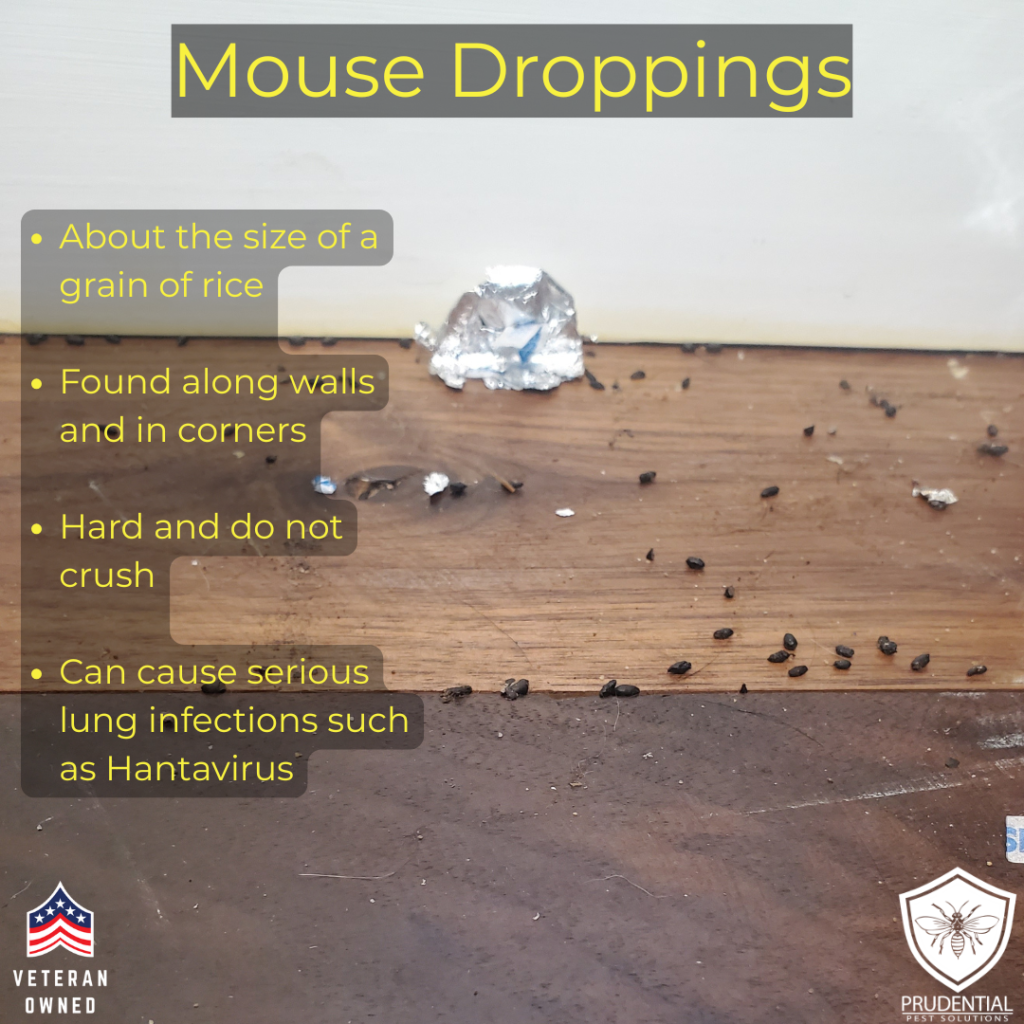
- Rice-shaped with pointed ends
- Hard and will not crush or crumble
- Will be scattered around but mostly found along walls, inside cabinets and drawers, and in corners
- Will not be in piles
- Hazards of mouse and rodent droppings include Hantavirus, a severe respiratory infection.
NEVER CLEAN-UP MOUSE AND RODENT DROPPINGS WITHOUT PROPER PROTECTIVE EQUIPMENT AND TRAINING!
How do professionals, such as Prudential Pest Solutions, safely remove bat and rodent droppings?
As we learned above, bat and rodent droppings can harbor some very serious health hazards. During the clean-up and removal of these droppings is when the risk is at it’s highest because the particles and viruses become airborne. When they are airborne is when they become a serious respiratory hazard.
It’s always a good idea to wet the droppings before removal. This can be as simple as spraying a disinfectant onto the droppings. The liquid disinfectant will help prevent the dangerous particles from becoming airborne and lessen the chance that you will breathe them in.
Wearing a properly fitted respirator is also required when handling and removing bat and mouse droppings. Even when the droppings are wetted and disinfected, there is always a possibility that some particles will be airborne. The respirator will filter these out so that you can continue to work and not be exposed to respiratory illnesses.
Once the droppings are wetted, we use a HEPA filtered vacuum to remove the droppings. The HEPA filter keeps the small particles trapped in the filter and does not allow them to be discharged from the vacuum back into the surrounding air.
A homeowner, following the guidelines above, can probably safely remove small amounts of bat and rodent droppings. What about huge infestations though?
When do you need to have a professional remove the bat and mouse droppings?
- When the piles of bat droppings are large, you need to hire a professional. We have seen bat guano piles so large that they come up to your knees!
- When the mouse droppings are so numerous that it is not safe for a homeowner to handle and remove them
- When a homeowner does not have the necessary protective equipment such as a quality respirator, HEPA Vacuum, or disinfectant.
- When the homeowner is grossed out by the thought of handling the bat or mouse droppings themselves.
Call Prudential Pest Solutions for fast, accurate droppings identification
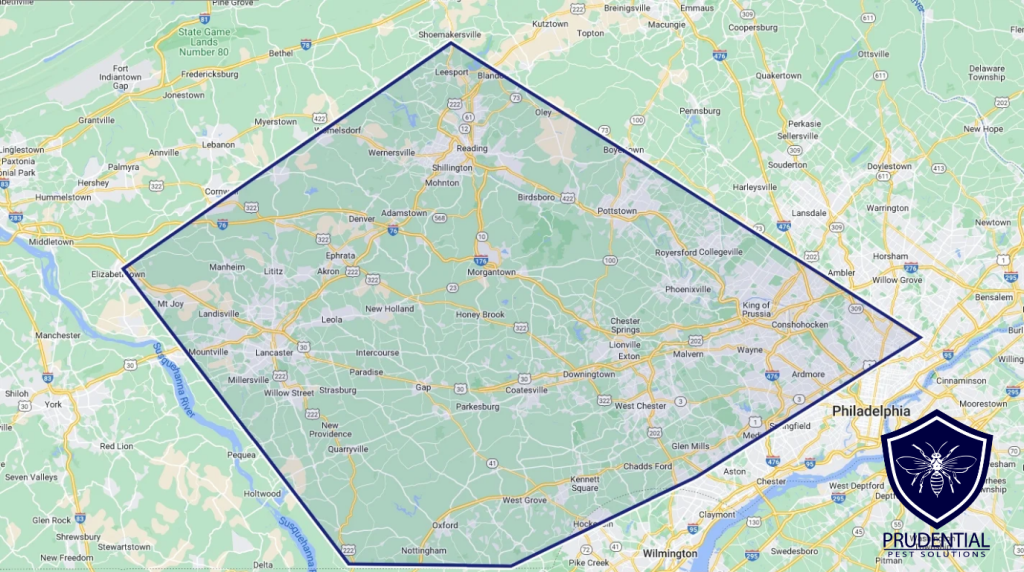
Our licensed and insured technicians in Pennsylvania provide:
- Free dropping identification (photos accepted via email or text)
- Safe, legal bat exclusion and guano cleanup with HEPA vacuums
- Mouse and Bat sealing and sanitation services
- Proud members of the National Wildlife Control Operators of America, Pennsylvania Pest Management Association, and the National Pest Management Association.
Call (484) 401-4361 or fill out the form below to schedule your free inspection today. Prudential Pest Solutions, protecting Pennsylvania homes from pests since 2018.
Comments are closed